


If you work in the machine manufacturing industry, selecting the right compressed air equipment is essential for maintaining production efficiency and reliable machine operation. There are several types of industrial air compressors available, including fixed-speed rotary screw compressors, variable speed drive (VSD) compressors, and reciprocating air compressors.
Among these options, oil-injected rotary screw compressors are widely used in machine manufacturing because of their ability to operate for extended periods and deliver a consistent supply of compressed air. They are particularly suitable for manufacturing facilities where pneumatic tools, automated machinery, and production equipment require a continuous supply of air.
Variable speed drive (VSD) technology also helps improve energy efficiency by adjusting compressor motor speed according to actual air demand.
There are several machine manufacturing applications that benefit from oil-injected screw compressors, including:

- Pneumatic tools used on assembly lines
- Operation of robotic arms and automated machinery
- Precision cutting, drilling, and metalworking
- Milling and grinding operations
- Pneumatic clamping systems
- Paint spraying and surface finishing
- Industrial mist lubrication systems
- Material handling, conveying, and packaging equipment
When selecting compressed air equipment for machine manufacturing, it is important to understand how different compressor technologies work and which solution best suits your operating requirements.
How a Rotary Screw Compressor Works
Compared with reciprocating compressors, rotary screw compressors use a different compression mechanism. Reciprocating compressors use pistons moving inside cylinders to compress air, whereas rotary screw compressors use two rotating helical rotors.
Reciprocating compressors are generally less expensive initially and are suitable for applications with intermittent compressed air requirements. However, applications requiring continuous operation may benefit from rotary screw technology because of its ability to deliver a steady supply of compressed air.
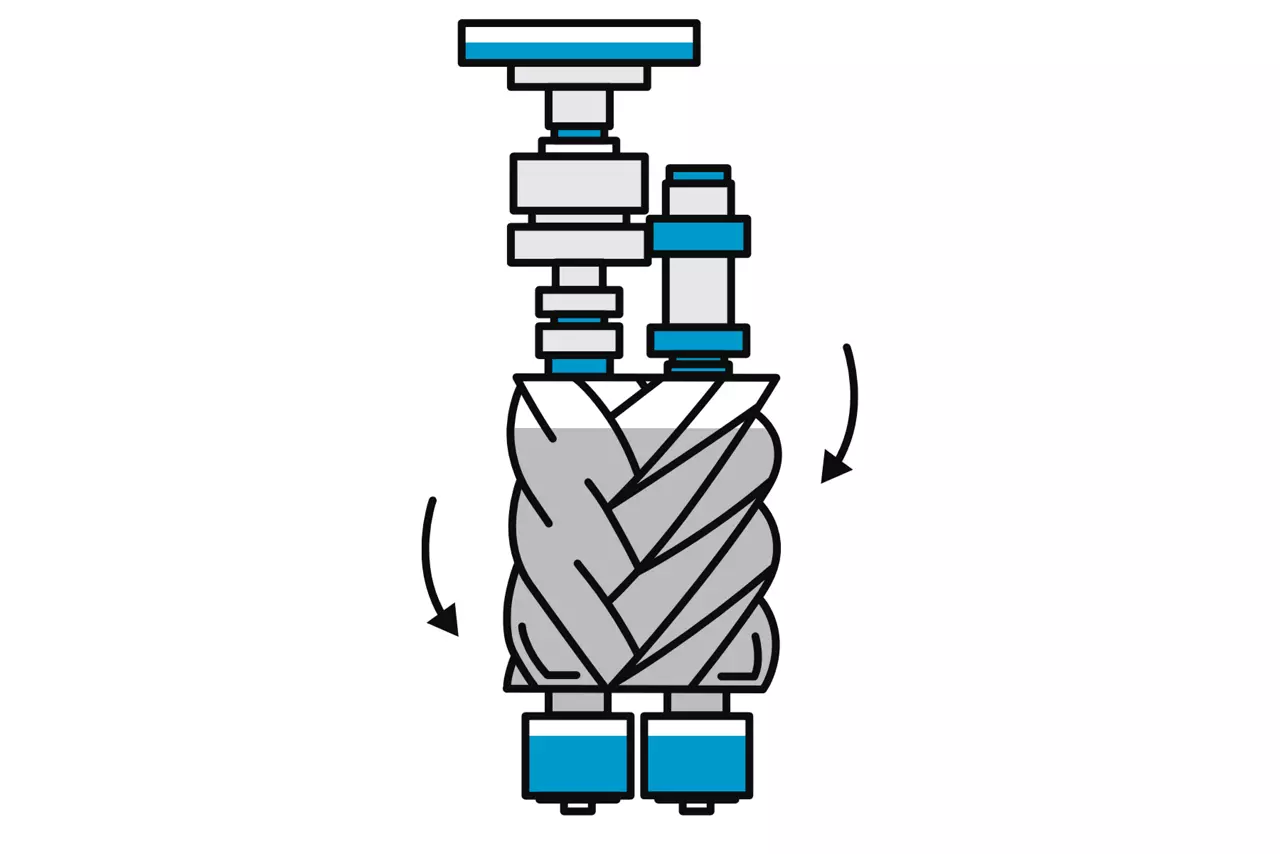
A rotary screw air compressor contains two main components: a male rotor and a female rotor. These rotors rotate in opposite directions inside a specially designed housing.
As the rotors turn, atmospheric air enters through the intake valve and becomes trapped between the rotor profiles and compressor housing. The available space gradually decreases as the air moves along the rotors, increasing its pressure.
The compression process continues until the air reaches the required pressure and moves towards the discharge outlet.
The compression ratio and rotor design determine the pressure developed during operation.
This is the basic working principle of a rotary screw air compressor.
In industrial applications, rotary screw compressors are commonly available in different operating configurations. The two main types are fixed-speed and variable speed drive compressors.
Fixed-speed compressors operate at a relatively constant motor speed, while VSD compressors automatically adjust motor speed according to compressed air demand.
When air consumption remains consistent, fixed-speed compressors can provide a practical and economical solution. However, when compressed air demand changes throughout the day, VSD compressors can help reduce unnecessary energy consumption.
A VSD compressor slows down when air demand decreases and increases its speed when demand rises. This allows the compressor to match air production more closely with actual consumption.
Although VSD compressors generally involve a higher initial investment, their potential energy savings can improve long-term operating economics.
An Oil-Injected Screw Compressor vs Oil-Free Compressor
Apart from compressor technology, another important consideration is the lubrication method used during the compression process.
Oil-injected and oil-free rotary screw compressors are designed for different industrial air quality requirements.
In an oil-injected screw compressor, lubricating oil is introduced directly into the compression chamber. This oil performs three important functions:
- Cooling: Absorbs heat generated during the compression process.
- Lubrication: Reduces friction between moving components.
- Sealing: Helps minimise internal air leakage between the rotors.
After compression, the air and oil mixture passes through an oil separator. Most of the oil is removed before the compressed air moves towards the downstream cooling and filtration equipment.
Oil-injected compressors are commonly used in general machine manufacturing, engineering workshops, automotive production, and industrial assembly applications.
However, small amounts of oil may remain in compressed air after separation. Therefore, suitable filtration and air treatment equipment must be selected according to the required air quality.
Oil-free rotary screw compressors operate differently. They are designed so that oil does not enter the compression chamber.
These compressors use specialised rotor designs, timing gears, and alternative cooling arrangements. They are commonly selected for applications where oil contamination must be strictly controlled, including certain food processing, pharmaceutical, and electronics manufacturing operations.
Oil-free compressors generally involve a higher initial investment because of their specialised design and engineering requirements.
For general machine production and assembly applications, an oil-injected compressor may be suitable when the required compressed air quality can be achieved through appropriate air treatment.
It is important to check the applicable ISO 8573-1 compressed air quality class before selecting a compressor. This standard helps determine the required levels of solid particles, water, and oil in compressed air.
Depending on the application, suitable air filters and dryers should be installed to achieve the required air quality.
Explore our industrial air compressors and air compressor spares for your manufacturing requirements.
If you need assistance selecting the right compressor or maintaining your existing equipment, contact Utility Engineers. Our team can help you identify suitable compressed air solutions for your industrial operations.